Showing posts with label Pathfinder Tales. Show all posts

Friday, November 30, 2012

Radovan & Jeggare Chronology Updated

Most of my recent work features Count Varian Jeggare and his hellspawn bodyguard, Radovan. You can dive in at any point. While there is a "mythology" running through their adventures, each is basically a "monster of the week" episode, although there aren't always monsters, and the novellas and novels are more like mini-series.
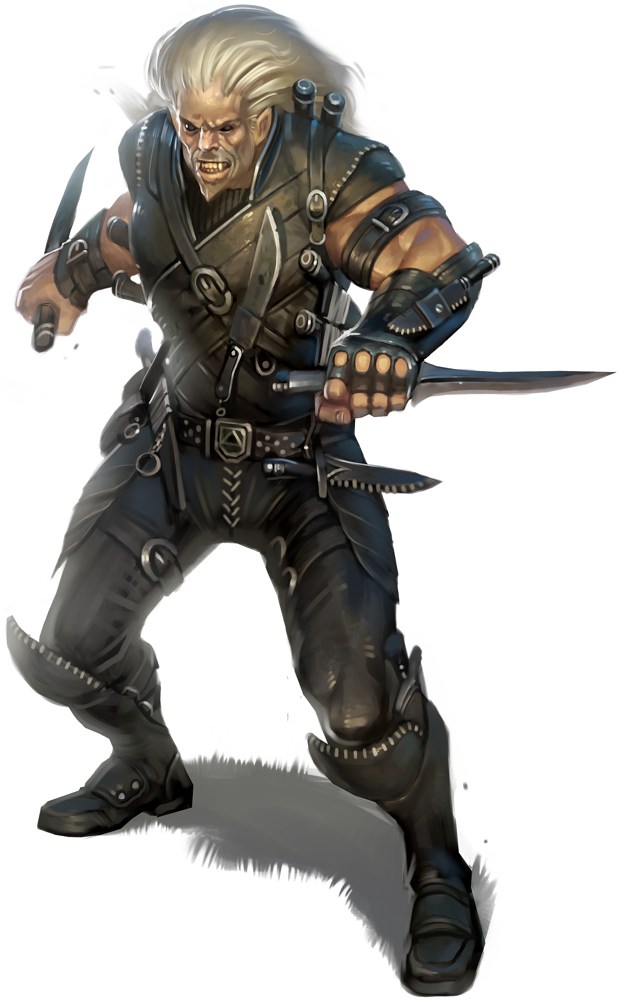
Eric Belisle's depiction of
Radovan, from "Hell's Pawns."
©Paizo Publishing, LLC®.  

"A Lesson in Taxonomy."* While this is chronologically the first story, don't read it first. Read it after Prince of Wolves, or at least after "the Lost Pathfinder." Trust me on this. It's told from Varian's POV.

"Hell's Pawns." This novella originally appeared in the Council of Thieves Adventure Path. It's distinct from the other stories in that it's told only from Radovan's POV and in the present tense. It's the first story I wrote with "the boys."

"The Lost Pathfinder,"* The first installment of Paizo's free web   fiction feature. Each week there's another free story chapter, complete with a painting. You can also buy the older ones in ePub format for your library.

Prince of Wolves was the first Pathfinder Tales novel. Months after I wrote it, I realized just how many elements it has in common with Black Wolf. I won't spoil them for you here, but if you dug one, you'll probably dig the other.

"A Passage to Absalom"* is a mystery set aboard a sailing ship. It bridges the events of Prince of Wolves and "Husks." This one is told from Varian's POV.

"Husks" is another novella, this time from the Jade Regent Adventure Path. It's my homage to my favorite samurai and yakuza films.

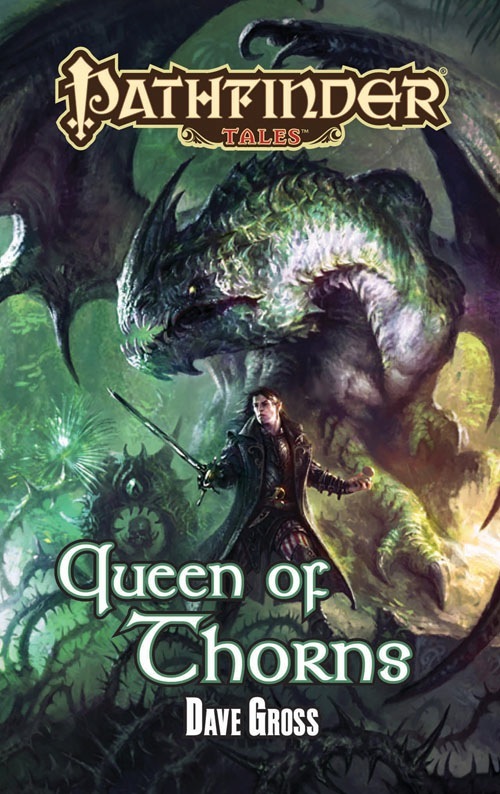
Mathias Kollros created this gorgeous cover featuring

Count Jeggare.
©Paizo Publishing, LLC®. 
Master of Devils is my love letter to wuxia movies. If Prince of Wolves is "Indiana Jones in Transylvania," this one is "The boys vs. every Kung Fu Movie Ever."

"Killing Time"* is a nasty little tale set in Absalom, between the most recent two novels. It's not yet available in ePub format, but you can read it free like all the web fiction.

Queen of Thorns is the third Radovan & the Count novel, this time set in what Radovan calls "Elfland" and the count knows to be the elven nation of Kyonin. Even more than the previous novels, this one is inspired primarily by the Pathfinder setting rather than genre films.

* These stories are still available free at Paizo's web fiction page, along with many other stories.

Saturday, December 3, 2011

Pathfinder Tales on iTunes

I should mention more often that the Pathfinder Tales novels are available via iTunes. If you prefer Kindle, I understand it's a cinch to translate the files to that format.

Here is as good a place as any to start, especially if you like gothic mysteries. Or perhaps you would prefer something more Asian-influenced? Of course, you could always start at the beginning.

All of the Pathfinder Tales novels and many of the Pathfinder Journals and web fiction are available via iTunes. Check 'em out.


Sunday, November 20, 2011

Prince of Wolves Review

Fifteen months after the book's release, Prince of Wolves continues to receive reviews from readers discovering the line for the first time. This one from Geeklore is among the best written, and it might also be the most positive review of the book I've seen.

Since the reviewer wasn't previously familiar with Pathfinder or Golarion, it could be the perfect review to show someone who's on the cusp about trying the Pathfinder Tales line.

My day, she is made.

Thursday, November 10, 2011

Upcoming Events II: Pathfinder Tales Web Fiction Chat

At last we’ve mastered time and space!

In November, to accommodate people in more time zones, we’re hosting two Pathfinder Tales chats, each featuring about ten authors of Pathfinder Tales short fiction.

Authors expected* to attend include Richard Lee Byers, Elaine Cunningham, J.C. Hay, Howard Andrew Jones, Liane Merciel, Erik Mona, Kevin Andrew Murphy, Steven Savile, Amber E. Scott, James Sutter, Bill Ward, and Yours Truly.

To prepare for the event, check out the glorious and free web fiction.

The events officially last one hour, but some folks hang out much later, so come on by even if you must be late. To join the event, point your browser to chat.dmtools.org, choose a screen name, and type “/join PFTales.”

Pathfinder Tales Web Fiction Chat I
Saturday, November 19
12:00 PT

Pathfinder Tales Web Fiction Chat II
Monday, November 21
18:00 PT

* A few guests have cautioned me that their attendance depends on the day job, traffic, and similar obstacles.

Monday, October 24, 2011

Pathfinder Web Fiction

Face it, you've seen that cute cat video so often its every frame is burned into your retina. Take a break and check out some of the nearly two score Pathfinder Tales stories available online.

Here you'll find some terrific fiction by Elaine Cunningham, Robin D. Laws, Howard Andrew Jones, Ed Greenwood, Amber E. Scott, Liane Merciel, Richard Ford, Robert E. Vardeman, Richard Lee Byers, Erik Mona, Monte Cook, Bill Ward, J.C. Hay, Kevin Andrew Murphy, James L. Sutter, and yours truly.

Reading those stories is free, although you can buy an ePub copy if you'd like to add some of them to your personal library. If you enjoy a story, the best way to support the line and the author is with a review. Even if you have read only the free version, please consider posting a rave on one of these product review pages.

If it's all the same to you, I suggest starting with those stories that have not yet received a review. And if you've a few more minutes of free time, please consider cross-posting a link to your review to spread the word.

Monday, September 19, 2011

Pathfinder Tales Live chat

One week from tonight, on September 26, join the first five Pathfinder Tales novelists for a live chat. It all begins at 6:00 pm Pacific Time (9:00 pm Eastern).


Elaine Cunningham (Winter Witch), Dave Gross (Prince of Wolves, Master of Devils), Howard Andrew Jones (Plague of Shadows), Robin D. Laws (The Worldwound Gambit), and James Sutter (Death's Heretic) will entertain your questions and discuss the pleasures and perils of writing shared-world fiction.

Point your browser to chat.dmtools.org and choose a nickname. Then type /join PFTales to join the event.

Wednesday, June 15, 2011

Guest Post: Robin D. Laws


Getting Tense

The Worldwound Gambit, my new Pathfinder Tales book from Paizo, is written in the present tense. Although this might be an unexpected choice for a gaming tie-in novel, I can hardly claim it as any kind of stunning innovation. As is the case with most developments in prose style, present tense narration was first adopted over in the halls of literary fiction. Over the course of several generations, it has spread out through the various genre scenes, taking root in categories as diverse as crime and chick-lit. Celebrated exploiters of the present tense include James Ellroy, Hilary Mantel, and Emma Donoghue. Not to mention that rogue avant-gardist, Charles Dickens. Closer to geekish shores, William Gibson, perhaps the most accomplished prose stylist in science fiction today, makes exacting use of it in Pattern Recognition. You’ll also find it in the latest book series turned pop culture phenomenon, Suzanne Collins’ Hunger Games trilogy.

The only justification for any stylistic choice in fiction, whether it’s tense, viewpoint, tone, or anything else, is that it best expresses the material. The Worldwound Gambit blends traditions, combining the swords and sorcery baseline of any Pathfinder Tale with the heist genre (with a heaping order of demonic horror on the side.) The heist sometimes plays with time, but above all takes place in the moment—sometimes in split seconds that spell the difference between a successful score or doom for its roguish anti-heroes. Its characters likewise plan cunningly for the future but think and exist entirely in the present.

The extent to which you feel a sense of discomfort with present tense will depend on your familiarity with the style. This in turn will largely be a function of your bookshelf’s generic and stylistic breadth. Even if you’re well-immersed in it, it is meant to be ever so slightly unsafe and disorienting. Present tense prose thrusts character and readers alike into an unfamiliar and sometimes uncomfortable future. Together they encounter the story’s events for the first time, shorn of the comforts of retrospection. It presents the character’s experiences before they have been digested into memory. In other words, it’s the perfect choice to tell the story of a carefully assembled gang of thieves who decide to combat an Abyssal invasion by staging a clandestine robbery in the literal heart of a living, demonic tower.

Any other benefits the style yields occur strictly on the margins.

The secondary result I’d most hope for is that any cognitive dissonance the tense provokes pays off in a richer reading experience. The works of art that have always struck the greatest and most lasting chords with me over the years are those that bend the rules, challenge perceptions, and take the audience to unanticipated places. In prose fiction the writers whose work lingers with me most strongly are those willing to indelibly stylize. My personal list of perception-bending prose stylists might start with the aforementioned Gibson and Ellroy, along with Jack Vance, William S. Burroughs, Cormac McCarthy, Dashiell Hammett, Ford Madox Ford, and Jim Thompson. None of these writers tries to efface himself behind an invisible prose style, and that’s why their work remains in my library throughout periodic purges of my limited shelf space. That’s how someone like the litfic-pop culture genre-blender Adam Marek has established himself a compelling voice and future star.

Another secondary benefit is that the present tense annoys curmudgeons. (Notable example: Philip Pullman.) Although the vexation of aesthetic grumps should never be a consideration while conceiving and writing a novel, it always represents a nice cherry on top afterwards.

No one will mistake The Worldwound Gambit for a daring work of literary experimentalism. This is no exploration of fragmented viewpoints, like Faulkner’s The Sound and the Fury, or Georges Perec’s A Void, famously written without the use of the letter “e.” It’s a story about thieves and swords and monsters and impossible feats, sprinkled throughout with curtly witty dialogue. If I had to encapsulate my objectives for it in a single phrase, I’d say “escapism for smart people.”

The surest route to mediocrity is to write down to the audience, to assume that they aren’t bright enough to adjust to an unusual stylistic mode or step outside familiar boundaries. By following that path, the writer winds up with a book he himself wouldn’t read, and thus has no way of evaluating. The great thing about working with Paizo is that the team cares about their world, and telling exciting stories that grab them. They know how smart their audience is, and value that intelligence. I might get a note suggesting that I should incorporate such-and-such a creature from a bestiary book, or evoke a certain mood at a certain point. The most common note is one asking me to steer clear of an element being used in another story or adventure. Never have I been told to dumb something down, or take a safer path, because they’re afraid you won’t get it. Whether or not you dig my book or key into its choice of tense, that's a show of deep respect I’d hope Pathfinder Tales fans appreciate for the rarity it truly is.

Blog: http://robin-d-laws.livejournal.com
Twitter: @RobinDLaws
Facebook: Robin D. Laws

New fiction: The Worldwound Gambit and "The Ironroot Deception"
Upcoming game: Ashen Stars
New non-fiction: Hamlet’s Hit Points
PaizoCon 2011


PaizoCon 2011 was a blast, even after an exhausting three-week marathon at the Seattle International Film Festival, itself a blast, but probably my last such visit while I live so far away as to require lodgings.

Notable highlights included catching up with old friends (some of them met only at last year's convention), a visit to the Science Fiction Museum (sadly bereft of its original installation, but the Avatar and Battlestar Galactica exhibits were neat), many fun bar conversations, and a couple of readings of Master of Devils.

The readings were especially fun, since they helped me shake off the rust of not doing public readings for a few years before Prince of Wolves. I look forward to reading more at Gen Con. I'm told the readings have been recorded and okayed for an upcoming podcast. I'll link to it when I learn details.

Tomorrow, watch this space for an excellent guest post by another of my Pathfinder Tales colleagues. You won't want to miss it.

Golem image copyright (c) Paizo Publishing.

Wednesday, May 18, 2011

Before Prince of Wolves

Many first encountered Count Varian Jeggare and his henchman Radovan in Prince of Wolves, but the novel is actually the third story featuring the boys. Originally I created them for a six-part serial appearing in the Council of Thieves Adventure Path.

Now you can buy the novella separately in ePub format. Each story is independent of the others, although "The Lost Pathfinder" leads directly into Prince of Wolves. Here's what's available so far:

“Hell’s Pawns”

“The Lost Pathfinder”*

Prince of Wolves

“A Lesson in Taxonomy”* (in the free Wayfinder #4)

Also check out the other Pathfinder Tales available both free on the Web Fiction tab and in ePub or PDF format in the store. If you like them, please leave a comment or a review.


* Also still available for free at Paizo's Web Fiction page.

Tuesday, May 17, 2011

Detective Dee and the Mystery of the Phantom Flame

I almost wish I'd seen Detective Dee and the Mystery of the Phantom Flame before writing Master of Devils. The titular Di Renjie is an exiled investigator, not unlike my Count Jeggare, and I now see Andy Lau's striking face whenever I envision the venture-captain.

Some call Detective Dee a Tang Dynasty Sherlock Holmes (the Guy Ritchie version), an apt simplification that covers both the premise and details such as a hint of steampunk and the occasionally dodgy CGI. I Sammo Hung's action choreography and the breathless blend of action and magic that recalls director Tsui Hark's classic 1990s fantasies.

Based on the novel by Lin Qianyu*, the plot offers an excellent template for a Pathfinder adventure. Commanded by the Empress to investigate apparently supernatural murders, Di and a pair of suspicious assistants (including Deng Chau, pictured) explore such exotic locations as a colossal Buddha, the Imperial city, and a subterranean Phantom Market. If the procedural elements are not always convincing, the intrigue, spectacle, and over-the-top action more than make up for the fuzzy border between logic and magic.

Gamers will enjoy the fantasy elements, my favorite of which is Di's sword-shaped mace, able to detect the weak point of any object and destroy it with a blow. Spontaneous combustion, magical disguises, clockwork traps, and conjured animals fit neatly into a Pathfinder game.

At film festivals, I usually skip movies I've already seen or expect to see soon. I'm making an exception for Judge Dee, since I'd like to see it among fellow fans in anticipation of Pathfinder's Tian Xia setting this summer.


* Western audiences met Di Renjie, inspired by an historical figure, through the pulp novels of Robert van Gulik, who called him Judge Dee. Other characters from the film, including the Empress, are also based loosely on real persons.